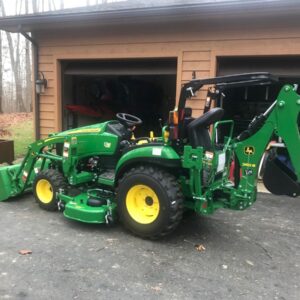
Understanding how to operate and maintain a John Deere 2025R helps you plan mowing, loading and digging while keeping the tractor and its attachments in good condition. This guide is written for the John Deere 2025R Tractor – 184 Hours with Attachments listed by Supreme Galaxy LDA.
The advertised package includes a used tractor with 184 recorded hours, hydrostatic transmission, four-wheel drive, a front loader, a mid-mount mower deck and a backhoe. The listing does not establish the exact attachment model numbers. Confirm those details, the current hour reading and the tractor serial number before choosing manuals or ordering parts.
This is an ownership overview. Use the operator’s manuals matched to the tractor and each attachment for control positions, starting procedures, ballast, slope limits, capacities and service requirements. The model name “2025R” is not proof that the tractor was manufactured in 2025.
Quick navigation
- Checks before operation
- Starting and driving
- Loader work
- Mowing
- Backhoe work
- Maintenance at 184 hours
1. Inspect your John Deere 2025R before use
Begin with the job and the ground conditions. Walk the route and identify holes, soft edges, slopes and overhead obstacles. Keep children, pets and other people outside the working area. Do not carry passengers on the tractor or attachments.
Inspect tyres, wheels, attachment mounts, hoses, pins and guards. Look for leaks and damaged components. Check engine oil, coolant and transmission/hydraulic levels using the manual’s checking conditions. Clean accessible cooling screens and confirm that the lights, instruments and controls are serviceable.
Test brakes and safety interlocks using the manufacturer’s procedures. Report defects and correct anything affecting safe operation before work. Never bypass a seat switch or starting interlock.
For tractor driving, keep the folding rollover protective structure (ROPS) upright and locked and wear the seat belt. If lowering the ROPS is unavoidable for clearance, follow Deere’s instructions, do not wear the belt with it folded, and restore the ROPS and belt use as soon as conditions permit. Backhoe seating may have different restraint instructions: follow the actual backhoe manual.
2. Start and drive the hydrostatic tractor
- Enter using the steps and handholds, adjust the seat and identify the controls.
- Apply the parking brake, disengage the PTO and place the transmission controls in the starting positions specified by the manual.
- Follow the diesel preheat and starting procedure. Check instruments after the engine starts.
- Allow the prescribed warm-up and test steering, movement and stopping in a clear area.
The 2025R uses hydrostatic drive with Twin Touch pedals for forward and reverse travel. Apply the pedals smoothly and become familiar with their response before working near structures or obstacles. Match the travel range and speed to the task; follow the specified stopping and range-change procedure.
Engine speed and travel speed serve different purposes. Set engine speed for the attachment’s requirements and use controlled pedal movement to adjust ground speed. Four-wheel drive can assist traction, but it does not remove the risks of slopes or unstable ground. Use the differential lock only as directed in the tractor manual.
For parking, stop on suitable level ground, disengage the PTO, lower attachments safely, apply the parking brake, stop the engine and remove the key. Wait for moving components to stop before leaving the operating position or inspecting equipment.
3. Operate the front loader
Identify the fitted loader and bucket. Check mounting security, attachment locking and hydraulic connections, then confirm Deere’s ballast requirements. A compatible loader model advertised elsewhere is not proof of what is fitted to this tractor.
Loader capacity depends on lift height, load position and attachment configuration. Deere’s 120R specifications, for example, distinguish capacity at the pivot from capacity measured farther forward. Use the data for the actual equipment; engine horsepower and bucket volume do not establish a safe payload.
Practise the loader controls without a load. Handle material smoothly and carry the load low during travel. Avoid sharp turns, side loading and driving with a raised bucket. Keep people clear and never use a loader bucket to carry or lift people. Do not adjust hydraulic relief pressure to increase capacity.
4. Use the mid-mount mower
Check the deck identification plate, cutting-height system, PTO driveline, guards and mounting points. Confirm the cutting width and whether the supplied deck has an AutoConnect arrangement rather than assuming every 2025R package is identical.
Remove debris from the lawn and keep people away from the discharge area. Follow the deck manual for PTO selection, engagement and operating engine speed. Reduce travel speed in dense grass instead of pushing through when the cut deteriorates.
Disengage the blades when travelling without cutting and follow the manual’s reverse-mowing and slope restrictions. Stop if anyone enters the area. Before clearing grass, inspecting blades or adjusting the deck, shut down, remove the key and wait for all motion to stop. Use approved mechanical supports if access beneath raised equipment is necessary.
5. Use the backhoe attachment
Identify the backhoe and mounting kit before use. Deere documentation lists a 260B arrangement for certain 2025R tractors, but this product listing does not confirm a 260B. Have a technician confirm compatibility, required hydraulic connections and the prescribed loader/ballast configuration.
Locate underground services before digging and assess excavation stability. Establish a clear swing zone and keep people outside it. Use the backhoe’s operator position, control pattern and stabiliser setup exactly as its manual directs.
Practise controlled movements before excavation. Avoid undermining the tractor, stabilisers or trench edges. Work within the equipment’s capability and do not use the boom for improvised lifting tasks. Before transport, secure the backhoe in its specified travel position with the required locks. Follow the manual’s seat and restraint instructions when changing between driving and digging.
6. Plan John Deere 2025R maintenance at 184 hours
Start with service records, not the hour meter alone. A low-hour used tractor can still need calendar-based servicing, and the reading does not prove that its initial service was completed. Request dated records showing the hours, fluids, filters and work performed.
John Deere’s October 2023 replacement-parts guide for the 2025R serial range beginning 1LV2025RCHH100001 lists engine oil and filter changes every 200 hours or annually, whichever comes first. It also lists 200-hour/annual transmission-hydraulic and front-axle fluid service. An older Deere guide covering 2025R tractors through HH100000 identifies different filter arrangements and initial filter servicing. These publications must not be treated as one universal schedule.
At 184 hours, there are 16 operating hours to a 200-hour point if that interval applies to the actual tractor. The annual limit, prior servicing and serial-specific instructions may make work due sooner. Ask a Deere technician to confirm the applicable schedule before planning the next service.
| Area | What to establish |
|---|---|
| Engine | Correct oil, filter, capacity and hour/calendar interval |
| Transmission and hydraulics | Applicable filter arrangement, lubricant and initial/repeat service requirements |
| Front axle | Fluid specification, level-check procedure and replacement schedule |
| Loader and backhoe | Grease points, mounting checks and wear limits in their own manuals |
| Mower | Blade, belt, driveline and lubrication requirements for the deck model |
Before maintenance, isolate the machine and attachments as directed. Release stored hydraulic pressure using the prescribed procedure and support raised components mechanically. Never rely on hydraulics alone to hold equipment above you.
Let hot components cool. Do not open a hot pressurised cooling system or search for hydraulic leaks with your hands. Have pressure-system repairs and structural or safety-system faults handled by qualified personnel. Use approved replacement fluids and parts rather than selecting products solely by a general “tractor oil” label.
Clean, record and store the package
After shutdown, remove grass and dirt using the approved cleaning methods. Keep cooling areas clear and protect electrical components, seals and intake openings from inappropriate pressure washing. Inspect for fresh damage and leaks as you clean.
Record every service with its date, hour reading, parts and next due point. Follow the manuals for seasonal fuel, battery and storage preparation. Attachment removal needs the proper stands, supports and sequence; request a demonstration before attempting it. Repeat pre-use checks when returning the tractor to work.
Enquire about the John Deere 2025R attachment package
Visit the John Deere 2025R Tractor – 184 Hours with Attachments product page for the offered unit and delivery enquiries. Request its serial number, attachment model plates, service history and a working demonstration before purchase.
References: John Deere manuals and training; 2025R model information; 2025R parts guide, HH100001 onwards; and earlier 2025R filter guide. These resources support planning; the manuals applicable to the actual machine remain the operating reference.