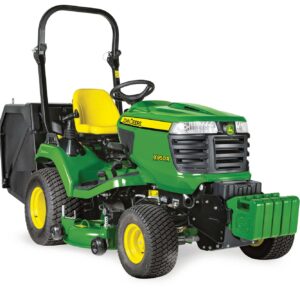
Knowing how to operate and maintain a John Deere X950R helps you organise mowing, grass collection and regular servicing. This guide is written for buyers of the John Deere X950R Diesel Mower – 2025 Model listed by Supreme Galaxy LDA.
Our listing describes a 54-inch rear-discharge deck, hydrostatic transmission and a 570-litre hydraulic low-tip collector. Confirm the fitted equipment and serial number at handover. Use the operator’s manual matched to that serial number for control positions, slope limits, fluid specifications and the complete service schedule.
Quick navigation
1. Check your John Deere X950R before mowing
Walk the work area first. Remove stones, branches and loose objects; identify holes, drop-offs and other hazards. Keep children, pets and bystanders away. Do not mow where traction or stability is doubtful, and do not carry passengers.
Inspect the mower for leaks, damaged hoses, loose components and missing guards. Check tyres, steering, brakes, seat and safety switches using the manual’s inspection procedures. Review engine oil, coolant and other fluid levels as instructed. Correct faults affecting safe operation before starting work.
Record the hour-meter reading. A machine advertised with very low hours still needs its delivery checks and any initial service requirements confirmed.
2. Start and operate the diesel mower
- Read the control labels and adjust the seat before starting.
- Take the operator’s position, disengage the mower PTO and secure the machine against movement.
- Follow the X950R manual’s starting sequence, including any diesel preheat indication. Use its specified throttle position and starter limits.
- After starting, check the instruments and allow the prescribed warm-up before applying load.
- Practise gentle forward movement, stopping and turning with the blades off in a clear, level area.
For mowing, select the cutting height, lower the deck and engage the PTO using the prescribed procedure. Hydrostatic travel control lets you adjust ground speed to the grass conditions. Reduce travel speed when collection or cut quality deteriorates rather than pushing through heavy growth.
Plan smooth mowing passes with room for turning. Turn the blades off when travelling without cutting. Before reversing, disengage the blades and check behind you; avoid mowing in reverse. Follow the serial-specific manual for slopes and any reverse-operation controls.
3. Use the grass collector correctly
The machine on our product page is listed with a low-tip hopper. Its emptying arrangement differs from a high-tip configuration, so check the actual hopper controls during handover.
Choose a firm, level emptying point and keep everyone clear of the hopper’s movement. Follow the manufacturer’s unloading sequence and make sure the collector returns to its operating position before resuming work. Never reach into a chute or collector while components can move.
If clippings stop collecting properly, stop and park safely before inspection. Check for accumulated grass in the approved access areas. Do not defeat hopper-presence switches or run the machine with an incomplete collection or discharge arrangement.
4. Park and clean after use
Park on level ground, disengage the blades, lower attachments, apply the parking brake, stop the engine and remove the key. Wait until all movement stops before leaving the seat or inspecting the deck. Let hot components cool before cleaning or storage.
Empty the collector and remove grass from the deck, chute and engine area using the methods allowed in the manual. Debris around cooling components can restrict airflow. Clean accessible screens carefully and avoid damaging radiator fins or directing high-pressure water at vulnerable components.
Inspect for fresh leaks and damage while cleaning. Keep air-filter servicing separate from general debris removal: do not wash paper filter elements or assume that blowing them out is an approved cleaning method.
5. Plan John Deere X950R maintenance
The table below summarises John Deere’s October 2023 X950R replacement-parts guide. It is a planning reference, not a verified 2025 serial-specific schedule. Confirm first-service requirements, calendar limits and severe-duty adjustments in your machine’s operator’s manual.
| Service item | Interval in the published parts guide |
|---|---|
| Engine oil | Every 200 operating hours |
| Engine oil filter | Every 200 hours or annually |
| In-line fuel filter | Every 200 hours |
| Primary and secondary air filters | Every 600 hours or annually |
| Transmission/hydraulic oil and filter | Every 400 hours or two years |
Use fluids, filters and grease approved for the actual machine. Check capacities and part applicability before ordering; never choose an oil solely because its container says “diesel.” Follow the specified lubrication points and intervals.
Blade replacement, sharpening, balancing, deck adjustment and belt work require the correct isolation, support and tightening procedures. Have a qualified technician perform work beyond your training or equipment. Do not work beneath an unsupported raised deck or hopper.
6. Keep a service record
For each service, record the date, operating hours, work completed, parts fitted and next due date. Add notes about recurring collection problems, vibration or warning indications. Keeping the record with the machine’s identification details makes future parts enquiries and servicing easier.
Before seasonal storage, clean the machine and follow the manual’s fuel, battery and storage procedures. Before returning it to work, complete the pre-operation inspection again.
Get support for your X950R
For availability, fitted equipment and delivery enquiries, visit the John Deere X950R Diesel Mower – 2025 Model product page. Ask for the serial number and supplied operator’s manual before purchase.
Find model-specific publications through John Deere Manuals and Training. The maintenance reference above is the official X950R replacement-parts guide. John Deere also provides safety and inspection resources.